
1) The 12 Commandments of Making Comics
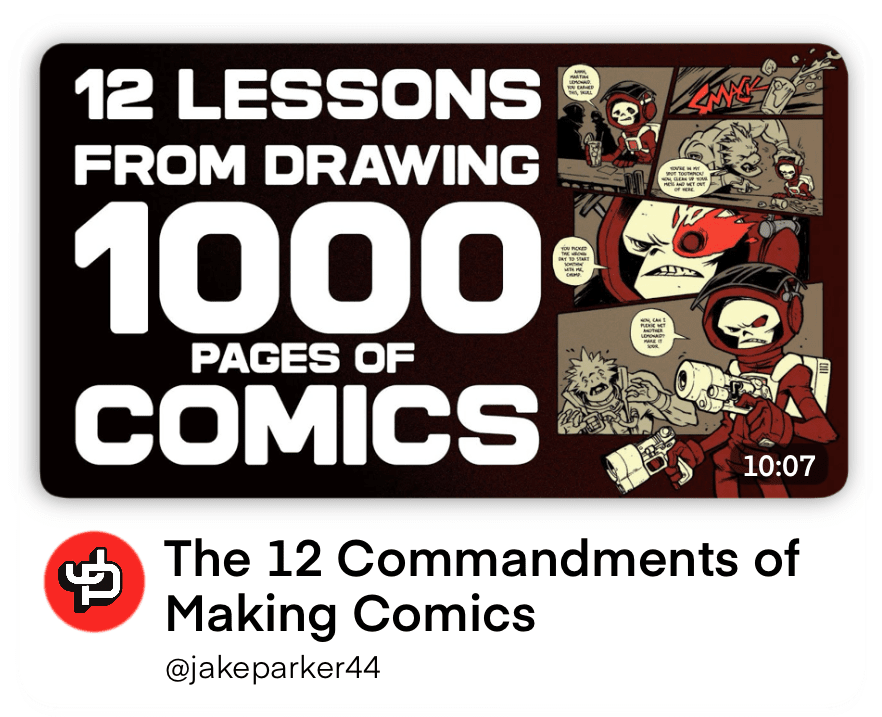
Veteran comic creator and illustrator Jake Parker has a set of “Commandments” for making comics. 📋
I came across it a while back and I’m revisiting it again as I’m in the process of making my own short comic for ‘The Sandbox Anthology’ on kickstarter.
Here’s are the Commandments 👇

1) Finish the comic.
This is the one rule you don’t break. Nobody remembers half-finished projects. they remember the people who ship things.
When you finish, you separate yourself from 99% of creators.
2) Word balloons lead the eye.
They have the highest contrast on the page. Use them intentionally to guide the reader. Sloppy word balloon placement = confused readers.
3) Respect the “Z-path.”
Readers automatically scan comics left-to-right, then top-to-bottom. Don’t fight this instinct. Use it to design your compositions. Use the ‘Z’
4) Clarity beats “cool.”
Focus on being clear with your panels over ‘looking cool’. If ‘cool’ kills clarity – Choose Clarity. Story first, design second.
5) Use whatever tool helps you finish.
Ink, digital, 3D models, stick figures, it doesn’t matter. If it keeps you moving and helps you finish, it’s good.
6) Know your ending before you start.
When you know where the story lands, the beginning and middle become 10x easier. Even if you’re drawing someone else’s script, read the ending first.

7) Panels = pacing.
Panels are time. More panels = slower moment. Big panels = big beats. Use panel design to control rhythm, tension, and breathing room.
8) Sound effects are storytelling.
SFX aren’t decoration. They’re part of the emotion, the texture, the world-building. Treat them like a design element, not a last-minute add-on.
9) Every scene needs an establishing shot.
A simple wide shot at the start saves readers from confusion later. Establish place, then tell the story.
10) Comics aren’t movies.
Lean into what only comics can do. Stylized panels, playful layouts, beautiful page design. You’re not storyboarding a film. You’re building an experience.
(I kinda disagree with this one though – Kesh)
11) Think like a theatre stage.
Suggest just enough background to sell the scene. After you’ve established the environment, you don’t need to render every brick in every panel. Let the reader’s imagination do some lifting.
12) Color sets the mood.
Color isn’t decoration. It’s emotional direction. Use palettes to define mood, scene, character arcs, tension, atmosphere.
And finally, Jake adds that “all rules are breakable, except rule one”
Here’s a video Jake has made explaining each points in detail. 👇
2) Don't think about Others when making Art
Art is personal.
It’s the expression of the self.
And you lose that expression when you keep thinking about how it will be received while making it.
Make the first draft of your work for yourself. The rest can wait.
(A note to self)
3) Favourite Quote of the Week
“You can’t have virtue without sin. What I’m after is having my characters’ virtues defined by how they operate in a very sinful environment. That’s how you test people.”
– Frank Miller, Creator of Sin City on storytelling
That’s it.
I’ll see you again next week 🙂
Best,
Kesh.

 Practical Life Advice,
 Actionable Art Tips and
 Weekly Quotes &